
About
A cellist who builds cellos
I grew up in a small town in the Basque Country, in a house where music was not just a hobby. I have played the cello for forty years, thirty of them professionally. Eight years ago I started building them.
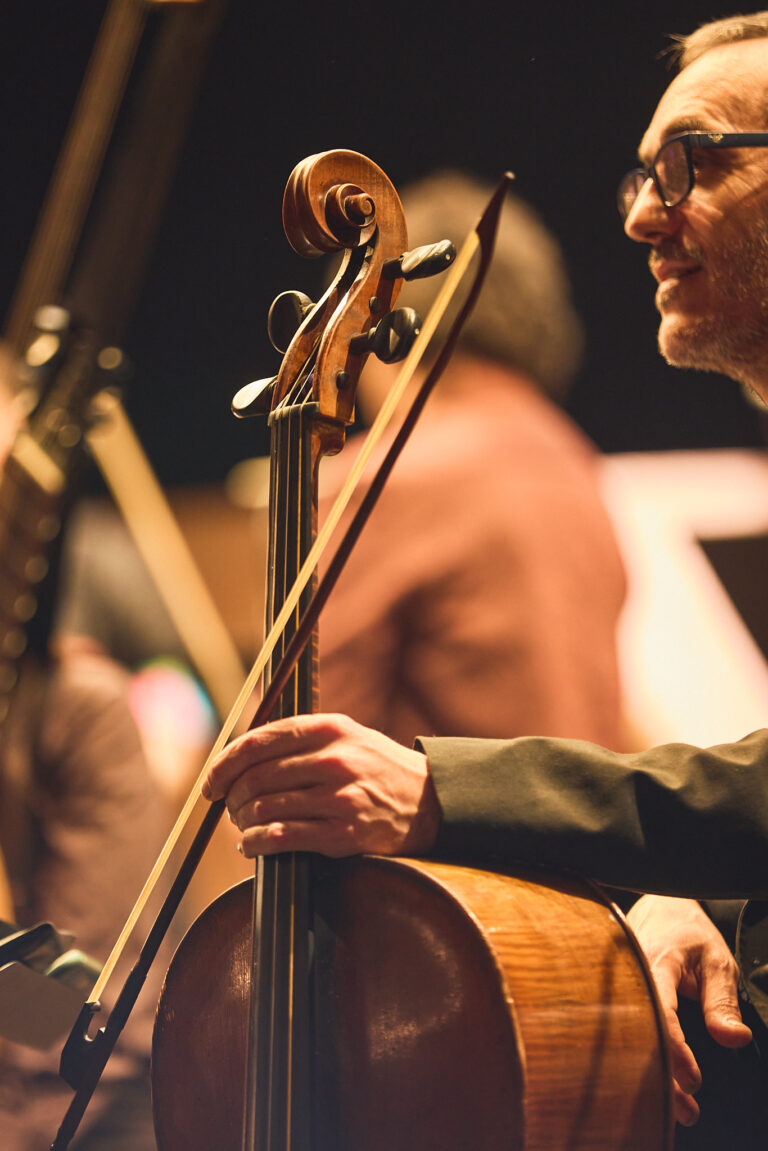
The cello came first
I have given my life to the cello. It came from home: music was the family trade, in three dialects — popular, modern and classical. It was a profession, and nobody doubted that it could be one.
I met the cello at the music school and I have not put it down since. Then came the conservatory, and from there the cello has paid my rent — orchestras, chamber groups, tours, hotel rooms in cities I had never seen.
I still play, though less and less. I am less freelance and more in the workshop, and what I take on is projects: a baroque orchestra for a few weeks, a tour, three concerts in a row and everyone back home.
The cello I play is from 1760. It is smaller than the ones built today, and I bought it for two reasons: I had spent years in early music, and I knew that instrument would give me work. It has.
Early music taught me that an instrument belongs to its period, and that it should be built for the music of its own time. Then the idea turns around on itself: to play the music of today only with the instruments of the eighteenth century is also a loss. I love the old cello, but I do not believe it is the only truth.
The fuse
An instrument is born from a need, not from an idea.
Eight years ago the small cellos did not arrive. The ones children start on — a half, a quarter, an eighth of a cello — were nowhere to be found in Catalonia, because the container from China was late, as it is late every year when demand peaks.
My wife brought that problem home. She said: make them in carbon fiber.
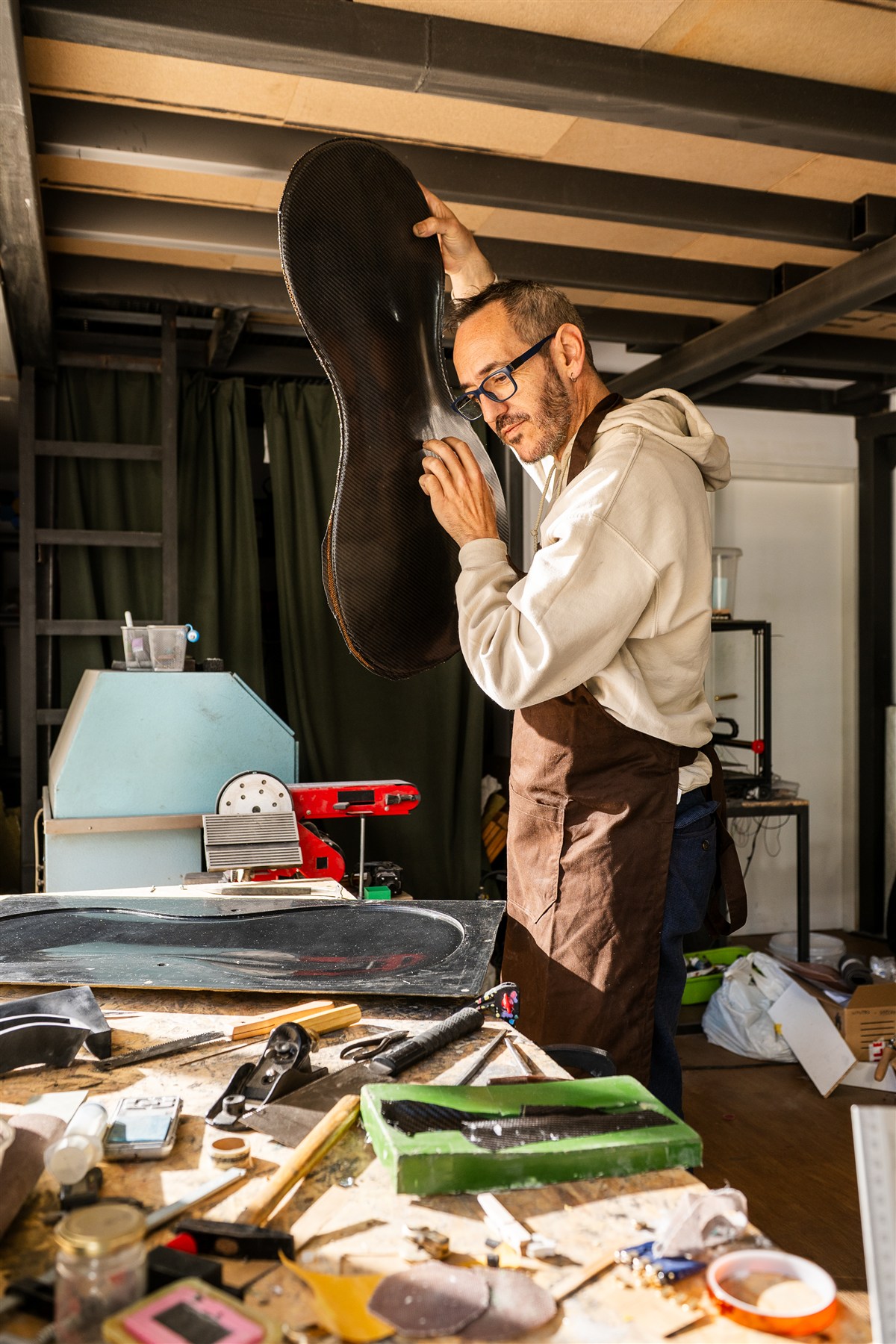
I did not sleep that night, and I have not stopped since. First came a tin of car body filler that I opened at home; the smell of polyester decided that this was not kitchen work. Then a rented corner in an industrial cooperative in Barcelona, at night, because during the day I had another job. The first mould took more than a year and broke a good number of masters. The first piece that came out of it was a tailpiece.
That is when 123sonar started: my wife took the commercial side, I took production, and the two of us went looking for a way to make it real. We found a workshop in Terrassa, and through contacts in the composite industry we could order violin moulds — we did not dare to make those yet. Out of those moulds came the first violin. After that we came closer to the startup world: business angels, an accelerator. That is where I understood what decides things here, and I said it to the investors myself: this is not an explosive market, it is slow and reluctant. And no high-end instrument exists without a luthier’s name behind it.
What I listen for
When a client plays one of mine for the first time, the word I hear most is «how easy». That is not a small thing. I am a cellist: I know what I would want for myself. A warm, wide, resonant sound. My years playing early music are behind that.
It should not take effort to make the sound.On the one thing I would not forgive in an instrument
There is a point where power, warmth and response come together, and then playing the instrument gives a very particular feeling of happiness. That point is what the work is for.
The material is nothing without a recipe. The direction of the fibres, how stiff, how much resonance — all of that can be changed. The rest is setup: a very good instrument with the bridge too high is not one that does not sound; it is one you cannot play.
It is like a potato omelette: every cook has their own recipe.On the material, and the sound
And there is a part nobody writes down: some orchestras still will not accept a carbon cello, and in modern music the more distinctive the instrument, the better. Knowing which one you are is part of the job.
A trade that does not exist
This trade has no school. There is no guild of it, no exam, no master to apprentice under. It drinks from lutherie, from composites, from acoustics and from simulation, and as a trade it does not exist yet — so I made my own curriculum. I learned from an acoustics teacher who built historical pianos, from a designer of hypercars who knows composites better than anyone I have met, from the luthiers who have spent decades measuring these instruments with science, and from a Belgian who wrote about flax before the rest of us were listening.
My first instruments followed the method the first carbon instruments had used: back, ribs, neck and head in one piece, and the top apart. The problem was control — with the back glued to everything else you cannot decide its mass or its stiffness. Little by little I dissected the structure, and now it is practically the traditional one: back, ribs, neck and head as separate pieces that are assembled. That way I can weigh, measure and tune each piece before it joins the rest.
Laminating is magic. You take a cloth and a piece comes out, very light and very rigid. I enjoy the tops and the ribs most. I have spent a lot of time on small things — a border worked into the lamination itself, for instance.
And the last thing that happens to an instrument here is a decision: whether it works or not. Everything before that is the way there. That decision is mine, and it is what makes me a luthier.
Now
The workshop is in Terrassa, in a quiet pedestrian street next to the conservatory, five minutes from home. It is a place of processes, production and invention: machines I have built or adapted, an oven, a printer, and instruments waiting in the corners.
Now everything is measured. Every piece passes an acoustic check before and after assembly, and simulation decides the next step. If a top comes out lighter, the whole instrument is built in that proportion — the proportions of a traditional cello with different numbers. Acoustics first; aesthetics works for acoustics.
I want it small, permanently under construction and still inventing. I am happy here, and I am in no hurry.
Write to me
I put everything I have into what I make here.
Tell me what you play and what you would like your instrument to be like. I will answer with what I can build and with what I still need to know.

